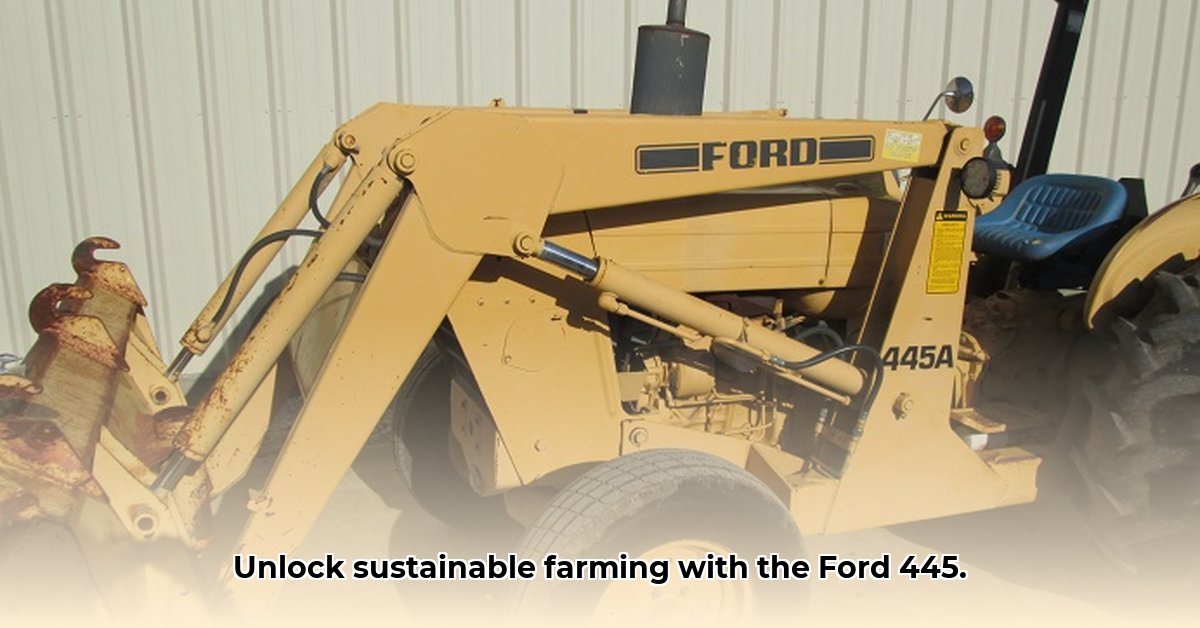
The Ford 445 tractor, manufactured between 1979 and 1983, presents a unique proposition for modern sustainable farming. Its lower horsepower output (45-52 hp) translates to reduced fuel consumption, a significant advantage in today's environmentally conscious agricultural landscape. However, its age presents challenges that require careful consideration before integrating it into a farming operation. This guide examines the Ford 445's suitability for sustainable agriculture, analyzing its technical specifications, lifecycle costs, and practical implications for farmers. For more information on Ford tractor serial numbers, check out this helpful resource.
Technical Specifications and Operational Suitability
The Ford 445's two-wheel-drive system and 16-gallon fuel tank restrict its application to smaller farms or specialized tasks. Its lower power output, while beneficial for fuel efficiency, limits its suitability for large-scale operations requiring higher power demands. However, the ability to add attachments like front-end loaders and backhoes significantly enhances its versatility. Therefore, a careful assessment of the farm's specific needs is crucial before considering the Ford 445. "The Ford 445's power is adequate for smaller farms or specialized applications but insufficient for extensive operations requiring high power output," states Dr. Emily Carter, Agricultural Engineering Professor at Purdue University.
Lifecycle Analysis: Cost and Environmental Impact
The age of the Ford 445 directly impacts its lifecycle costs. Sourcing replacement parts can be challenging and expensive; repair costs vary widely depending on part availability and mechanic expertise. This high repair risk must be factored into the total cost of ownership. However, restoring a well-maintained 445 can still prove less expensive than purchasing a new tractor.
The environmental impact of repair versus replacement is complex. While manufacturing a new tractor generates a significant carbon footprint, the high transportation costs associated with sourcing rare parts for the 445 can negate the initial lower-fuel-consumption environmental benefit. A comprehensive lifecycle assessment—considering manufacturing, operation, maintenance, and disposal—is essential to determining its overall ecological footprint.
Practical Considerations for Farmers
Before purchasing a Ford 445, farmers should meticulously evaluate several key factors:
Power Requirements: Accurately assess if the 445's 45-52 horsepower output meets the farm's specific needs. Overestimating its capabilities can lead to operational inefficiencies.
Parts Availability: Investigate the availability of parts both locally and online. A robust network of mechanics familiar with vintage tractors is invaluable.
Repair Cost Assessment: Obtain multiple repair quotes to gain a realistic understanding of potential maintenance expenses. This information is key when comparing the total cost of ownership against that of a new machine.
Total Cost of Ownership (TCO) Analysis: A thorough TCO analysis encompassing fuel costs, maintenance, potential repairs, and the time investment required for maintenance is vital for informed decision-making.
Sustainability and the Ford 445: A Nuanced Perspective
The Ford 445's sustainability depends heavily on context. Although its lower fuel consumption is advantageous, the potential drawbacks of higher maintenance costs, limited performance, and the environmental impact of parts procurement cannot be ignored. The equation goes beyond mere fuel efficiency; the entire lifecycle of the tractor needs to be considered when assessing its true sustainability. "Simply focusing on fuel economy isn't sufficient for evaluating the overall environmental impact," comments David Miller, Sustainable Agriculture Consultant at the USDA.
Risk Assessment: Potential Challenges and Mitigation Strategies
The following table summarizes the key risks associated with owning a Ford 445, along with suggested mitigation strategies:
| Factor | Risk Level | Potential Impact | Mitigation Strategies |
|---|---|---|---|
| Repairing the Ford 445 | Medium to High | High repair costs, failed repairs, parts scarcity | Thorough pre-purchase inspection, establish a parts network, develop repair skills, find a knowledgeable mechanic. |
| Ongoing Operation | Low to Medium | Lower fuel efficiency than modern tractors; higher maintenance, potential emissions | Optimize usage, diligent maintenance, explore emissions offsetting programs (if available). |
| Parts Obsolescence | High | Inability to repair, equipment failure | Explore part replication, 3D printing (where feasible), join vintage tractor communities for advice and parts. |
Regulatory Compliance: Legal Considerations
Farmers must research and comply with all local and national regulations concerning emissions, safety standards, and noise levels before operating the Ford 445. These regulations may differ from those in place during the tractor's initial operation.
The Ford 445 represents a compelling case study in the complex interplay between vintage technology and sustainable practices. Its ultimate suitability hinges on individual circumstances and careful planning, emphasizing the importance of due diligence before making a purchase decision.